




82.51×63 – A Complete Guide to Understanding Its Meaning and Uses
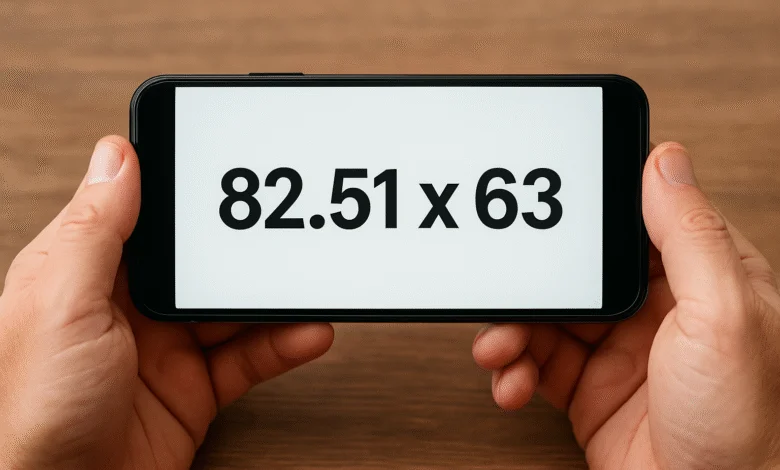
Numbers like 82.51×63 may seem random at first glance, but they often carry meaning in various fields. Whether you’re an engineer, designer, architect, or even someone working in digital graphics, you’ll likely come across such precise values. Understanding what 82.51×63 represents and how it’s applied can save you time, ensure accuracy, and help you make smarter decisions in both professional and creative projects.
In this guide, we’ll explore what 82.51×63 means, where it’s commonly used, how to convert it, and why such exact measurements matter.
What Does 82.51×63 Mean?
At its core, 82.51×63 is a representation of two numbers multiplied or paired together. Depending on the context, it can mean:
- Dimensions – for example, 82.51 units by 63 units in construction, design, or manufacturing.
- Aspect ratio or resolution – in digital graphics, where precise pixel sizes matter.
- Mathematical calculation – where 82.51 is multiplied by 63, resulting in 5,198.13.
- Identifiers or codes – sometimes such figures are used as unique reference numbers in data sets.
So, the meaning of 82.51×63 depends heavily on the industry or situation where it appears.
Technical Analysis of 82.51×63
82.51×63 in Dimensions and Measurements
In construction, architecture, and product design, 82.51×63 could describe exact measurements. Precision is critical here—being off by even a small fraction could lead to material waste, structural issues, or design flaws. For instance, a window pane sized 82.51 cm by 63 cm needs to be cut precisely to fit without gaps or stress points.
82.51×63 in Digital and Screen Formats
In the digital world, measurements often come in pixels. For example, an image with dimensions of 82.51×63 pixels would be extremely small, but scale matters depending on resolution (DPI or PPI). Graphic designers might use 82.51×63 mm as print size references, especially in brochures or cards.
82.51×63 as a Mathematical Value
When treated as a multiplication, 82.51 × 63 = 5,198.13. This can be used in data calculations, budgeting, or scaling formulas. Many scientific fields rely on such exact multiplications to ensure consistent outputs.
Applications of 82.51×63 Across Different Fields
In Architecture and Construction
- Describing panel sizes, tiles, or blueprints
- Flooring or wall layouts where precision ensures materials fit properly
- Structural elements where dimensions must align with engineering standards
In Technology and Digital Media
- Used in print design sizes (mm or cm)
- Aspect ratios for custom image cropping
- Referenced in digital mockups or templates
In Science and Engineering
- Applied in technical specifications like material testing or component sizes
- Data sets where exact values like 82.51 and 63 are part of formulas
Real-World Examples of 82.51×63
- Blueprint Example: A glass company might design panes exactly 82.51 cm by 63 cm for a set of windows.
- Digital Design Example: A poster designer could use 82.51 mm by 63 mm dimensions for a print section.
- Mathematical Modeling Example: In an experiment, values like 82.51×63 could represent two variables being multiplied.
Why 82.51×63 Matters and How to Use It
Precision numbers like 82.51×63 may seem small, but they carry big weight in professional settings. A difference of even 0.5 in measurements could:
- Cause misalignment in construction
- Distort digital graphics
- Alter outcomes in scientific research
When using such measurements:
- Always double-check unit conversions (cm, mm, inches).
- Verify if the figure refers to multiplication or dimensions.
- Document clearly to avoid misinterpretation.
Conversion Table for 82.51×63
Here’s a quick reference to help you interpret 82.51×63 across different formats:
| Format | Conversion Example | Usage Context |
| Inches to cm | 82.51 in × 63 in = 209.57 × 160.02 cm | Construction, design |
| Pixels to inches | Based on 300 DPI → ~0.27 × 0.21 in | Digital/print scaling |
| Decimal to fraction | 82.51 ≈ 82 ½; 63 = 63 | Engineering calculations |
| Multiplication | 82.51 × 63 = 5,198.13 | Mathematical modeling |
FAQs About 82.51×63
Q1: What does 82.51×63 stand for?
It usually represents either a measurement (length × width) or a multiplication of values.
Q2: How do you convert 82.51×63 into other units?
It depends on the units being used. For example, inches to centimeters, or pixels to millimeters.
Q3: Where is 82.51×63 commonly used?
In architecture, design, digital graphics, and mathematics.
Q4: Is 82.51×63 related to screen sizes?
Yes, it can represent pixel or aspect ratio measurements depending on the project.
Q5: Can 82.51×63 be used in coding?
Yes, especially in data sets, algorithmic scaling, and technical specifications.
Final Thoughts on 82.51×63
The value 82.51×63 isn’t just a random set of numbers—it’s a versatile measurement and calculation tool applied across industries. From blueprints to digital media, it shows up in places where precision is key. Understanding how to interpret and convert 82.51×63 helps you avoid errors, improve accuracy, and ensure better results in your projects.
When you see numbers like this, don’t brush them aside. They may hold the key to better design, smoother execution, or more reliable data.


Post Comment